Tests
A collection of operating tests for continuous integration and demonstration purposes is provided in the repository. This section describes what they are trying to achieve and how to use them.
Write and Couple
A surrogate geoscientific code with an hard-coded OASIS interface is emulated by toy_earth.py.
The script advances in time in accordance with parameters provided in the Fortran namelist earth_namelist.
models.py contains a dummy model add_100() that we wish to deploy within Toy Earth.
- Toy Earth intends to send:
one 2D time-evolving field
sst, with a hourly frequency, on grid(720,603)one 3D time-evolving field
svt, with a daily frequency, on grid(720,603,3)one fixed metric field
msk, only once, on samesstgrid
- and to receive from the Python model:
one field
sst_var, computed fromsst, with same dimensionsone field
svt_var, computed fromsvt, with same dimensions
Eophis script main.py aims to write coupling namelist, configure OASIS interface for models.py, and orchestrate connexions between exchanged data and add_100().
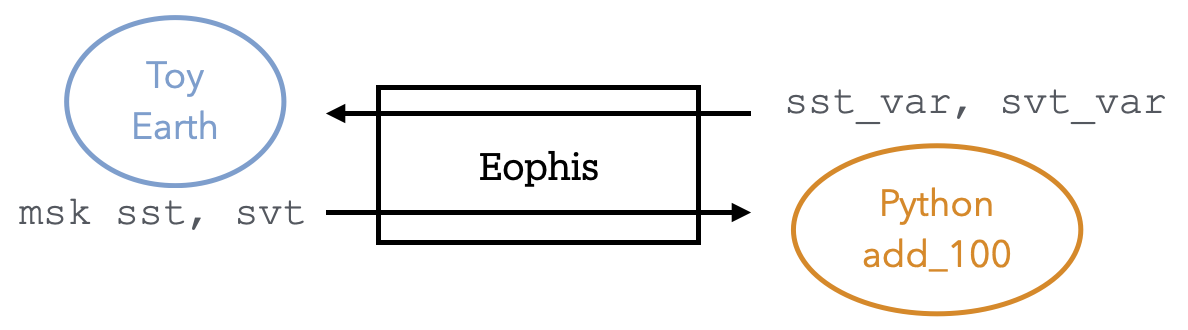
In addition to add_100(), Toy Earth adds 0.2 to sst and 0.5 to svt every time step. Given the number of time steps and exchanges, final values are theoretically known. Test is successful if final sst and svt correspond to theory, meaning that coupling and exchanges have been performed correctly, with right frequencies.
- It illustrates :
Preproduction and Production modes
Tunnel configuration and registration for regular and static exchanges of 2D/3D fields
Fortran namelist manipulation
Writing of coupling namelist
Tunnels opening
Assembly of a Loop and a Router
Model required global structure
Static exchange and start of time emulation for regular exchanges
- Following commands run the test (number of executing processes may be changed in Makefile):
make : execute commands below
make clean : remove working files
make preprod : execute eophis in preproduction mode to write coupling namelist
make prod : execute eophis in production mode for coupling with dummy earth system script
cd tests/write_and_couple
make
python3 ./main.py --exec preprod
mv eophis.out preprod_eophis.out
mpirun -np 1  python3 ./toy_earth.py : -np 1  python3 ./main.py --exec prod
TEST SUCCESSFUL
END OF WRITE AND COUPLE TEST
Halo Decomposition
A surrogate geoscientific code with an hard-coded OASIS interface is emulated by toy_earth.py.
The script advances in time in accordance with parameters provided in the Fortran namelist earth_namelist. models.py contains a dummy model deltaxy() that computes first order discrete differences along first and second axis.
Differences imply to know neighboring cells. Those will be missing at boundaries, especially if models.py is scattered among processes. Fields need to be received on the model side with at least 1 extra halo cell to compute correct differences. It is also required to determine the values of the halos located over the edges of the global grid.
- Thus, Toy Earth intends to send every time step:
psi, on Arakawa C-grid V points, with size(10,10,3), cyclic/NFold conditions and 1 halophi, on a standard grid, with size(10,10,2), closed/cyclic conditions and 2 halos
- and to receive from the Python model:
dxpsianddypsi, results fromdeltaxy(psi), defined on samepsigriddxphianddyphi, results fromdeltaxy(phi), defined on samephigrid
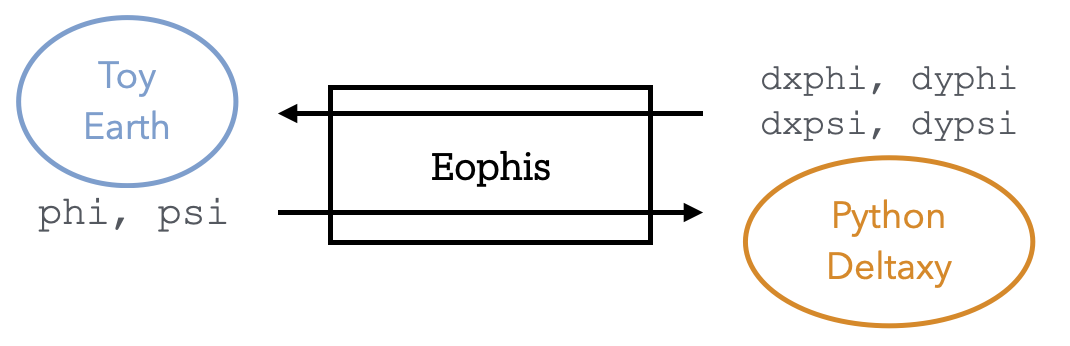
In reality, Toy Earth is supposed to send/receive real cells only, without halos. Eophis goal here is to achieve exchanges with correct automatic reconstruction and rejection of halos. Differences are also computed in Toy Earth and compared with returned results. Test fails if results do not match.
- It illustrates :
Definition of user-defined grids with halos
Definition of grids with different boundary conditions
Definition of exchanges with different grids within the same Tunnel
- Following commands run the test (number of running CPUs may be changed in Makefile):
make : execute commands below
make clean : remove working files
make preprod : execute eophis in preproduction mode to write coupling namelist
make prod : execute eophis in production mode for coupling with dummy earth system script
cd tests/halo_decomposition
make
python3 ./main.py --exec preprod
mv eophis.out preprod_eophis.out
mpirun -np 1  python3 ./toy_earth.py : -np 1  python3 ./main.py --exec prod
TEST SUCCESSFUL
END OF HALO DECOMPOSITION TEST
Toy Earth
A surrogate geoscientific code with an hard-coded OASIS interface is emulated by toy_earth.py.
The script reads the namcouple and eophis_nml files generated during preproduction phase. From those information, Toy Earth initializes the right number of arrays with right shapes, following main Eophis script.
Finally, the script advances in time and perform the exchanges of arrays, according to the defined coupling context.
Important
In fewer words, Toy Earth adapt its behavior to fit the Eophis main script. Purpose of this test case is to isolate Eophis script to assist in testing and tracking bugs without deploying a whole geophysical model.
- Prepare your test case:
Copy the Eophis main script and Python model to couple in Toy Earth directory
Copy any additional material required for the test case
- Following commands run the custom test (number of running CPUs may be changed in Makefile):
make : execute commands below
make clean : remove working files
make preprod : execute eophis in preproduction mode to write coupling namelist
make prod : execute eophis in production mode for coupling with dummy earth system script
Here is an example of Toy Earth used with Halo Decomposition Eophis scripts. Note here that Toy Earth is a response to the defined coupling context to test its validity, it won’t check what Halo Decomposition test case is supposed to achieve:
cd tests/toy_earth
# Prepare test case
cp ../halo_decomposition/main.py  .
cp ../halo_decomposition/models.py  .
cp ../halo_decomposition/earth_namelist  .
# Run test case
make
python3 ./main.py --exec preprod
mv eophis.out preprod_eophis.out
mpirun -np 1  python3 ./toy_earth.py : -np 1  python3 ./main.py --exec prod
END OF TOY EARTH TEST
Warning
Although Toy Earth test case is designed to adapt with any Eophis script, user specific features might prevent Toy Earth reaching end of execution, which does not necessarily mean failure. Check content of Eophis and Toy Earth logs. eophis.out should contains lines like these:
cat eophis.out
# [...]
Iteration 982: 1177200s -- 13 days, 15:00:00
   Treating sst received through tunnel TO_EARTH
   Sending back sst_var through tunnel TO_EARTH
Iteration 985: 1180800s -- 13 days, 16:00:00
   Treating sst received through tunnel TO_EARTH
   Sending back sst_var through tunnel TO_EARTH
and earth_log like these:
cat earth.log
# [...]
INFO:root:  Ite 563:
INFO:root:    Sending sst - E_OUT_0
INFO:root:    Receiving sst_var - E_IN_0
INFO:root:  Ite 564:
INFO:root:    Sending sst - E_OUT_0
INFO:root:    Receiving sst_var - E_IN_0